2026 Best Cold Plunge Tub for Global Buyers
Choosing the 2026 Best Cold Plunge Tub for Global Buyers requires more than comparing prices and glossy photographs. A reliable model should combine stable water temperature, safe electrical design, durable insulation, and practical maintenance. Buyers in Canada, Singapore, Germany, and Australia face different climates, voltage systems, delivery costs, and warranty conditions. These details matter.
Dr. Susanna Søberg, a leading cold-exposure researcher, describes cold exposure as “a form of hormesis.” Her view supports careful, measured use rather than extreme competition. A quality Cold Plunge Tub should therefore offer precise temperature control, clear operating instructions, secure covers, and filtration that is easy to clean. The water should feel controlled, not intimidating. It should also fit the user’s routine, whether installed on a balcony, beside a gym, or in a backyard.
This guide examines leading tubs through an international buyer’s lens. It considers cooling performance, construction materials, energy use, user comfort, after-sales service, and regional compatibility. Safety remains essential. Cold immersion may not suit everyone, especially people with certain heart or circulation conditions, so medical advice can be sensible before use. No product is perfect. Some tubs cool quickly but consume more energy; others save power but require patience. That trade-off deserves honest attention. Reviews can miss noise, condensation, replacement-filter costs, and difficult drainage. Real ownership is less polished. The best choice is not always the coldest tub, but the one that remains dependable, understandable, and safe over time.
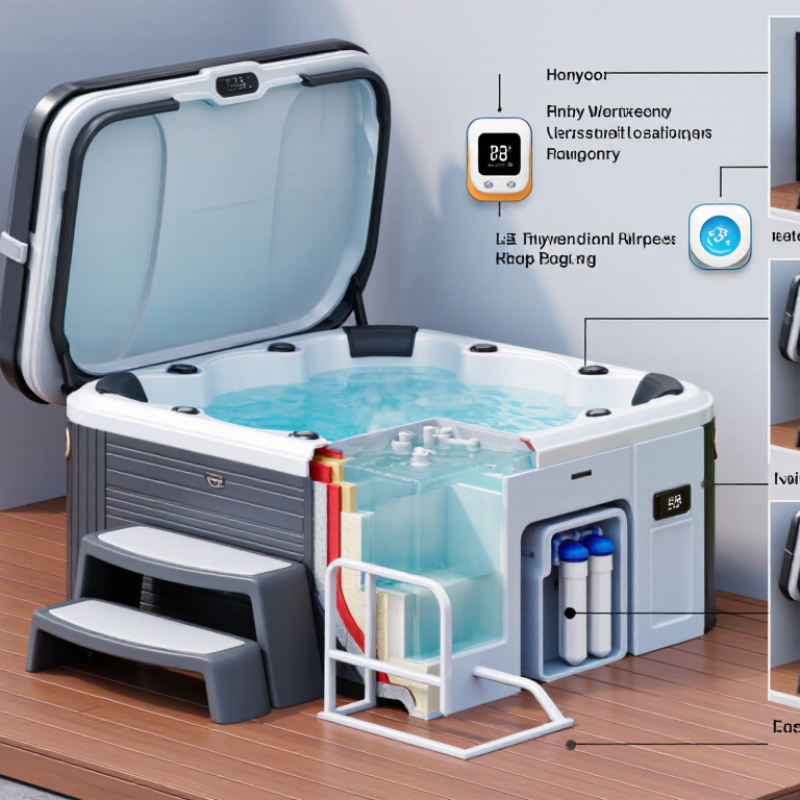
What Makes a Cold Plunge Tub Suitable for Global Buyers in 2026
2026 Best Cold Plunge Tub for Global Buyers
A suitable cold plunge tub must work beyond one climate, socket, or bathroom. The Global Wellness Institute’s 2024 Global Wellness Economy Monitor valued global wellness spending at $6.3 trillion in 2023. That growth increases buyer expectations for safer, more adaptable equipment.
Temperature control is central. Look for stable settings, clear Celsius and Fahrenheit displays, and protection against accidental overcooling. The American Heart Association warns that sudden cold exposure can sharply raise breathing rate and blood pressure. A reliable tub should support gradual entry, emergency shutoff, and easy supervision.
Safety comes first.
Global buyers also need voltage compatibility, certified electrical protection, and sealed components. Compliance with relevant IEC or regional standards should be verified, not assumed from a sales page. Water hygiene matters too. The World Health Organization’s drinking-water guidance supports regular disinfection and careful maintenance, although plunge tubs are not drinking-water systems.
Insulation reduces energy waste in hot or cold regions. Replaceable filters, local service access, and multilingual instructions can prevent expensive mistakes. Shipping dimensions matter in older apartments. So does drainage.
I would not trust impressive cooling claims alone. Real performance depends on ambient temperature, water volume, usage frequency, and lid quality. A compact tub may cool quickly, yet feel cramped. A larger model may offer comfort, but demand more energy and maintenance. That trade-off deserves honest checking before purchase.
2026 Best Cold Plunge Tub for Global Buyers
A cold plunge tub designed for global buyers should offer electrical configurations that match local household systems. The chart shows representative nominal residential voltages used in major markets. A region-specific or dual-voltage model can simplify installation, improve safety, and reduce compatibility problems. Always verify the local voltage, frequency, plug type, grounding, and circuit requirements before purchase.
Reference basis: nominal low-voltage supply values commonly specified in IEC 60038 and national electrical standards. Actual household voltage may vary by location.
Key Features to Compare Before Choosing a Cold Plunge Tub
2026 Best Cold Plunge Tub for Global Buyers
Key Features to Compare Before Choosing a Cold Plunge Tub
Choosing a cold plunge tub requires more than checking its lowest temperature. A practical starting range is 10–15°C for many users, while colder water increases discomfort and risk. Look for adjustable controls, a clear digital display, and a reliable timer. A 2022 review in Sports Medicine reported that cold-water immersion may support post-exercise recovery, but results vary by temperature, timing, and exposure length. The research is useful, not perfect.
Water management deserves serious attention. The CDC’s Model Aquatic Health Code emphasizes filtration, disinfectant control, and balanced pH in treated recreational water. Choose a tub with accessible filters, simple drain access, and visible water-quality guidance. Ozone or ultraviolet systems can assist sanitation, but they should not replace routine cleaning. That shortcut is tempting.
Insulation affects operating costs, especially in hot climates. Compare wall thickness, cover quality, cooling capacity, and noise levels. Global Wellness Institute data valued the worldwide wellness economy at 6.3 trillion dollars in 2023, showing strong demand for home recovery products. Yet market growth does not guarantee quality. Measure the entry step, seating depth, electrical requirements, and ventilation space before buying. A beautiful tub may still feel cramped. Safety features matter too, including non-slip surfaces, emergency shutoff access, and clear instructions for gradual exposure. Content claims should be treated carefully; personal tolerance differs widely.
How to Evaluate Cooling Systems, Filtration, and Energy Use
2026 Best Cold Plunge Tub for Global Buyers
How to Evaluate Cooling Systems, Filtration, and Energy Use
A cold plunge tub should hold its target temperature, not merely reach it once. Compressor-based systems usually cool faster and recover better after repeated use. Thermoelectric units can suit smaller tubs, but warm rooms may reduce their performance. During evaluation, measure the water after ten minutes and again after several users. A simple thermometer and plug-in energy meter reveal more than marketing claims. Insulation around the tub and pipes also matters. Poor insulation quietly increases electricity use.
Filtration deserves equal attention. Look for a replaceable filter, an accessible housing, and clear flow-rate information. A filter removes particles, but it does not replace proper water treatment. Check whether the circulation pump runs continuously or on a timer. Continuous circulation may improve consistency, yet it can consume more energy. Water temperature, usage frequency, and local electricity prices change the real cost. Global buyers should also verify voltage, plug type, outdoor ratings, and service support before ordering.
I would not judge efficiency from the lowest temperature alone. That test can hide slow cooling and heavy power demand. A better comparison records cooling time, daily energy use, noise, and temperature recovery. I once focused too much on cooling speed and overlooked cleaning access. That was a poor choice. A tub is easier to trust when its filters, drains, sensors, and electrical protections are simple to inspect.
2026 Best Cold Plunge Tub for Global Buyers - How to Evaluate Cooling Systems, Filtration, and Energy Use
| Configuration | Typical Water Capacity | Recommended Users | Achievable Water Temperature | Cooling Technology | Cooling Capacity | Typical Pull-Down Time* | Filtration and Water Treatment | Circulation Rate | Rated Electrical Input | Estimated Daily Energy Use** | International Power Compatibility | Best Use Case |
|---|---|---|---|---|---|---|---|---|---|---|---|---|
| Compact integrated chiller | 250–400 L | 1 person | 3–5°C minimum, depending on ambient conditions | Air-cooled refrigeration compressor with digital thermostat | 0.6–1.0 kW cooling output | 2–5 hours to reduce water from 15°C to 5°C | 20–50 micron replaceable cartridge; basic circulation pump; optional ozone or UV on some configurations | 10–20 L/min | 0.7–1.3 kW while cooling | 4–9 kWh at 15–25°C ambient | Usually 220–240 V, 50/60 Hz; 110–120 V versions require region-specific electrical design | Home users with limited space and moderate daily use |
| Standard integrated chiller | 400–650 L | 1–2 people | 3–6°C minimum, depending on insulation and ambient conditions | Refrigeration compressor with condenser fan and thermostatic control | 0.8–1.5 kW cooling output | 3–6 hours to reduce water from 15°C to 5°C | 20–50 micron cartridge filter; circulation pump; UV or ozone treatment recommended for frequent use | 15–30 L/min | 0.9–1.8 kW while cooling | 6–12 kWh at 15–25°C ambient | 220–240 V models are common; verify plug, frequency, breaker, and residual-current protection | Most residential buyers seeking a balance between capacity, performance, and energy use |
| High-performance insulated system | 500–800 L | 1–2 people | 2–5°C minimum, subject to ambient temperature and water turnover | Larger refrigeration compressor with insulated lines and high-efficiency heat exchanger | 1.2–2.2 kW cooling output | 2–4 hours to reduce water from 15°C to 5°C | 20–50 micron filter; continuous circulation; UV-C and/or ozone commonly available | 20–40 L/min | 1.2–2.4 kW while cooling | 7–14 kWh at 15–25°C ambient | Dedicated circuit may be required; confirm voltage, frequency, maximum current, and local certification | Frequent athletes, commercial recovery rooms, and warm-climate installations |
| Heat-pump reversible system | 400–700 L | 1–2 people | Approximately 4–40°C, depending on the operating mode | Reversible heat-pump compressor for both cooling and heating | 0.8–1.8 kW cooling output | 3–7 hours to reduce water from 15°C to 5°C | 20–50 micron cartridge; circulation pump; UV or ozone optional | 15–35 L/min | 1.0–2.0 kW while active | 6–13 kWh for cooling; heating consumption varies substantially with target temperature | Confirm whether the unit supports the local voltage and whether heating mode has regional operating limits | Users who want cold immersion and warm-water functionality in one system |
| Portable tub with external chiller | 250–450 L | 1 person | 4–8°C under favorable ambient conditions | Remote air-cooled chiller connected through flexible hoses | 0.5–1.0 kW cooling output | 4–8 hours to reduce water from 15°C to 5°C | Inline 20–50 micron filter; external pump; sanitation may require manual water treatment | 8–18 L/min | 0.6–1.3 kW while cooling | 4–10 kWh at 15–25°C ambient | Check hose fittings, plug type, voltage, frequency, and whether the chiller requires a grounded outlet | Renters, temporary installations, balconies, and buyers prioritizing portability |
| Commercial high-volume system | 800–1,500 L | 2–4 people, subject to hygiene controls | 5–10°C typical operating range | High-capacity refrigeration with commercial circulation and control components | 2.0–4.0 kW cooling output | 3–8 hours to reduce water from 15°C to 5°C | 20–50 micron pre-filter; high-flow circulation; UV-C and ozone may be combined; frequent water testing required | 30–80 L/min | 2.5–5.0 kW while cooling | 15–35 kWh at 15–25°C ambient | May require a dedicated circuit, professional installation, local electrical approval, and commercial drainage provisions | Gyms, clinics, hospitality facilities, and high-frequency shared use |
Energy basis: **Daily energy figures are typical operating ranges rather than guaranteed consumption. They assume the tub is covered when not in use and operated in approximately 15–25°C ambient conditions. Actual use may be higher in hot climates or with frequent water replacement.
Filtration: A cartridge filter removes suspended particles but does not independently disinfect water. Use a sanitation program suitable for the equipment, follow local health requirements, and test water chemistry regularly.
Global purchasing checks: Confirm local voltage, frequency, plug type, residual-current protection, maximum current, replacement-filter availability, warranty coverage, spare parts, drainage requirements, and applicable electrical certifications before purchase.
Cold Plunge Tub Safety, Maintenance, and Climate Considerations
Choosing the best cold plunge tub in 2026 requires more than checking water temperature. Safety, maintenance, and climate should guide every purchase. Place the tub on a level, slip-resistant surface with clear drainage. Keep electrical connections dry, protected, and installed according to local requirements. A nearby emergency shutoff is a sensible detail.
Clean water is not automatically safe water. Follow the manufacturer’s sanitation schedule, test water chemistry regularly, and rinse the filter before flow becomes weak. Shower before entering. Keep the cover secured when children or animals are nearby. Limit each session, especially for new users, and stop immediately if you feel dizzy, numb, or unusually cold. Never use cold immersion alone when you have a medical condition without professional advice.
Climate changes the maintenance routine. In hot, humid regions, water may cloud faster and algae can appear quickly if circulation is poor. In freezing climates, drain or winterize the system before temperatures fall below safe operating limits. Strong sunlight can also heat exposed plumbing and damage covers over time. Insulation reduces energy use, but it does not remove the need for testing. It is easy to assume a premium-looking tub is low maintenance. That assumption can be costly. Global buyers should check replacement-part availability, service support, drainage needs, and local weather before ordering. Some details are easy to overlook. Content should be reviewed against the latest local safety guidance.
How to Select the Best Cold Plunge Tub for Your Budget and Space
Choosing the best cold plunge tub starts with your budget and available space, not online popularity. The Global Wellness Institute’s 2024 Global Wellness Economy Monitor valued wellness at $6.3 trillion in 2023. That growth has expanded consumer choice, but also increased confusing specifications.
For small apartments, select a compact tub with a stable vertical footprint and at least 10 centimeters of clearance around service panels. A balcony requires more than floor space. Check structural loading, drainage, weather exposure, and electrical access first. For outdoor users, insulated walls reduce heat gain and may lower cooling demand. However, advertised energy savings vary with climate, water temperature, usage frequency, and cover quality. I would treat every estimate as a comparison, not a promise.
Budget beyond the purchase price. Include delivery, filtration cartridges, water treatment, electricity, maintenance, and replacement parts. The U.S. Department of Energy’s 2024 residential energy data shows that cooling loads vary widely by region, so operating costs cannot be judged from one national figure. Look for a clearly stated power rating, thermal insulation details, replaceable filtration, and electrical protection certified for your country. Follow the manufacturer’s sanitation instructions, and never ignore unusual odors, cloudy water, or damaged cables. A cheaper tub can become expensive when cleaning is difficult. That lesson is easy to miss.