7 Best End Dump Trucks for Sale in 2026?

Choosing an End Dump Truck in 2026 takes more than comparing asking prices. Payload, road conditions, maintenance access, and the tractor setup all affect how well a truck works on a real job. A unit that performs reliably on a dry highway may feel very different on a muddy site or steep grade.

This guide explores seven end dump trucks for sale in 2026 and the features buyers should examine before making a decision. We consider practical details such as trailer capacity, axle configuration, body construction, braking systems, and parts availability. Used-truck buyers should also inspect frame condition, hydraulic components, tires, and service records. A clean paint job can hide wear. Look closer.

There is no single best choice for every fleet. The right match depends on what you haul, how far you travel, and how often the truck operates. Listings and specifications can change, so confirm details directly with the seller and compare them with your operating needs. Some trade-offs are easy to miss. A larger payload may bring added weight, operating costs, or tighter maneuvering. This overview is a starting point, not a substitute for a careful inspection and a complete cost review.
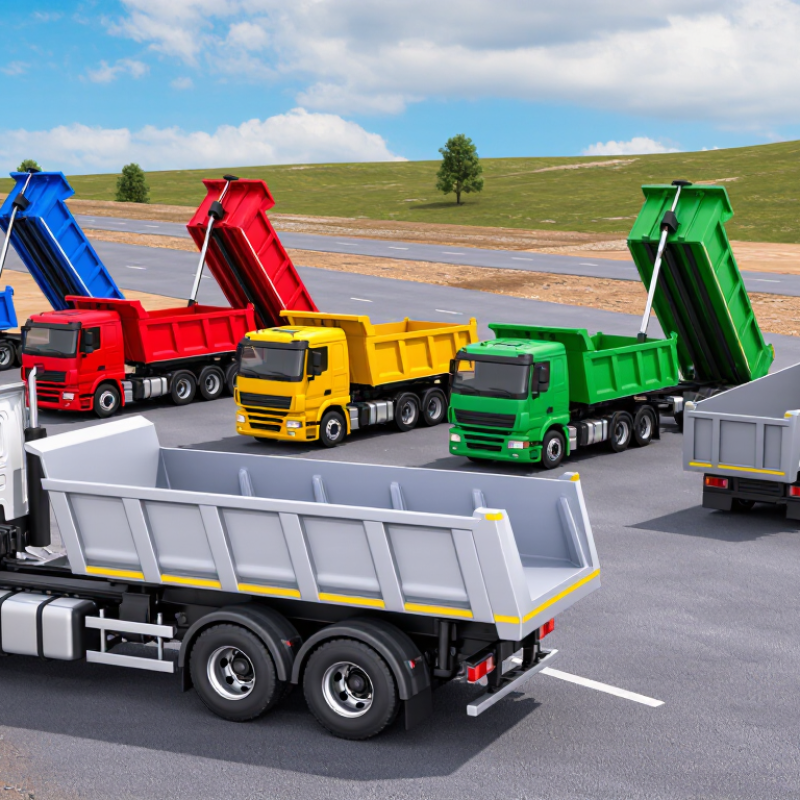
7 Best End Dump Trucks for Sale in 2026?

Define End-Dump Trucks by Body Design, Axle Layout, and Job Type

An end-dump truck is defined by more than its raised box. Its body pivots at the rear, releasing material through the open tailgate. Body material matters: steel handles repeated contact with sharp quarry rock, while aluminum can reduce empty weight for suitable loads. Neither is universally better. A gravel hauler may prioritize volume and fast cycles; a demolition operator may need a tougher body and careful control of mixed debris. When raised, the body lifts the truck’s center of gravity. Uneven ground deserves respect.

Axle layout shapes traction, turning, and how weight reaches the road. A 6x4 chassis, with two driven rear axles, suits many demanding haul routes; a truck-and-trailer combination can add capacity but needs room to maneuver. More axles do not automatically mean more usable payload. The Federal Highway Administration’s Freight Analysis Framework projects roughly 50% growth in U.S. freight tonnage through 2050, but it is a broad freight outlook—not an end-dump sales forecast. Match the truck to the work: quarry cycles, road-building aggregate, and short urban construction hauls demand different body volumes and maneuverability. Check route conditions, payload targets, and local axle limits before comparing listings. A spec sheet can make this look simpler than it is.

Compare Seven 2026 Trucks by GVWR, Payload, and Body Capacity

7 Best End Dump Trucks for Sale in 2026?
Compare Seven 2026 Trucks by GVWR, Payload, and Body Capacity

A useful 2026 comparison starts with seven buying profiles: compact single-axle, tandem-axle, tri-axle, quad-axle, lightweight-body, high-volume, and severe-duty configurations. NTEA’s vehicle-class guide places Class 6 trucks at 19,501–26,000 pounds GVWR, Class 7 at 26,001–33,000 pounds, and Class 8 above 33,000 pounds. These are weight classes, not payload promises. Payload equals GVWR minus the truck’s actual operating weight, including its body and equipment. Small details matter.

For initial screening, body capacities often run roughly 5–10 cubic yards for compact setups, 10–16 for tandem trucks, and 14–22 for larger multi-axle configurations. Lightweight or high-volume bodies may carry more space, but not necessarily more weight. The seven profiles should therefore be compared using the exact body dimensions, chassis weight, and rated GVWR on each specification sheet. A large body can reach its weight limit before it looks full.

Tips: Ask for certified empty weight and body capacity in writing. Then calculate payload, and check it against the material you haul; wet soil can make a half-full body surprisingly heavy. Treat generic capacity ranges as estimates, not verified truck data. I would not rank a configuration “best” until its axle ratings and typical route are known.

7 Best End Dump Truck Configurations to Compare in 2026

Compare representative GVWR/GCWR, payload, and body capacity. Figures are indicative planning estimates for common configurations—not certified specifications for any specific truck.

Payload depends on tractor and trailer tare weight, axle limits, body material, and local weight regulations. Combination weight limits can vary by route and jurisdiction; confirm rated specifications and legal limits before buying.

Check Payload Against FHWA’s 80,000-lb Interstate GVW Limit

When comparing the 7 best end dump trucks for sale in 2026, check legal payload before advertised volume. FHWA’s Federal Size Regulations for Commercial Motor Vehicles set the standard Interstate limits at 80,000 pounds gross vehicle weight, 20,000 pounds on a single axle, and 34,000 pounds on a tandem axle, subject to the Federal Bridge Formula. These are not simply truck-capacity figures. They include the tractor, trailer, fuel, driver, and cargo. Axle spacing and load placement matter, too.

A practical estimate is legal gross weight minus the truck’s actual operating tare. For example, an end dump weighing 28,000 pounds empty leaves up to 52,000 pounds on paper under the 80,000-pound cap. But axle limits or bridge-formula calculations may lower that figure. Ask for a certified scale ticket, then check the specific configuration and route. A brochure’s cubic-yard rating cannot confirm legal payload. It’s an easy detail to miss.

Tips: Weigh the complete rig with fuel, tools, spare tire, and accessories onboard. Compare axle-by-axle scale readings with FHWA’s limits, not just total weight. Recheck after changing the tractor, trailer, or load position; small tare differences can cut usable payload. State rules and exceptions vary, so confirm requirements with the relevant transportation agency before buying.

7 Best End Dump Trucks for Sale in 2026? - Check Payload Against FHWA’s 80,000-lb Interstate GVW Limit
Configuration Typical axle layout Estimated empty weight Payload at 80,000-lb gross weight* Potential fit Important check
Lightweight 5-axle combination 3-axle tractor + 2-axle end-dump trailer 26,000–31,000 lb 49,000–54,000 lb
(24.5–27 short tons)
Maximum payload potential where a lighter tare is a priority. Confirm trailer and axle ratings; a low tare does not ensure the load can be distributed legally.
Standard 5-axle combination 3-axle tractor + 2-axle end-dump trailer 28,000–34,000 lb 46,000–52,000 lb
(23–26 short tons)
A common starting point for general hauling comparisons. Check axle spacing and bridge-formula limits, not just total gross weight.
6-axle combination, 3 + 3 3-axle tractor + 3-axle end-dump trailer 32,000–38,000 lb 42,000–48,000 lb
(21–24 short tons)
A possible choice when added axle capacity suits the route and load. State axle-weight rules and permit requirements may affect allowable weight.
6-axle combination, 2 + 4 2-axle tractor + 4-axle end-dump trailer 33,000–39,000 lb 41,000–47,000 lb
(20.5–23.5 short tons)
May suit operations where a multi-axle trailer configuration is permitted. Verify tractor, trailer, axle-group, and route-specific limits before purchase.
7-axle combination 3-axle tractor + 4-axle end-dump trailer 35,000–42,000 lb 38,000–45,000 lb
(19–22.5 short tons)
A configuration to compare for heavier-duty hauling needs. More axles do not automatically authorize more than the applicable federal or state limits.
8-axle combination 4-axle tractor + 4-axle end-dump trailer 39,000–46,000 lb 34,000–41,000 lb
(17–20.5 short tons)
Worth comparing where local rules and the operating route support this setup. Confirm legal axle spacing, registration, and route access; requirements vary by state.
How to read these figures: Empty weights are broad planning estimates, not specifications for a particular truck or trailer. The payload figures are arithmetic estimates calculated as 80,000 lb minus estimated empty weight; they are not guaranteed legal or rated payloads. The federal Interstate limit is generally 80,000 lb gross vehicle weight, subject to federal exceptions and axle and bridge-formula limits. Actual allowable payload is also limited by the vehicle’s ratings, axle loads, state rules, permits, and route restrictions. Weigh the fully loaded vehicle and verify applicable requirements before operating.

Compare Engines Using SAE J1349 Net Horsepower and Torque Ratings

For 2026 buyers comparing end dump trucks, SAE J1349 net ratings offer a consistent starting point. The standard measures engine output under defined conditions, accounting for typical engine accessories. Compare net horsepower and torque figures, not ratings taken under different test methods. A larger horsepower number alone does not guarantee quicker, more confident hauling.

Check where peak torque occurs, too. Torque delivered at lower engine speeds can help a loaded truck pull away on a grade without constant gear changes. Look at the rpm listed beside each rating. Then consider axle ratios, transmission gearing, and intended payload; these shape how engine power reaches the wheels. Ratings are useful, but they cannot predict every jobsite. Dust, heat, altitude, and maintenance all matter. I would not choose from a spec sheet alone.

Tips: Ask for the full SAE J1349 engine data sheet. During a test drive, note shift frequency on a familiar hill. Compare trucks at similar weights, and record fuel use over repeatable routes. Small details count. A polished brochure can make one figure seem decisive, and I still find it easy to overvalue peak horsepower. Check the complete setup before deciding.

Assess Safety, Warranty, and Ownership Costs Using FMVSS and TCO Data

7 Best End Dump Trucks for Sale in 2026?

Assess Safety, Warranty, and Ownership Costs Using FMVSS and TCO Data

A low purchase price means little if brakes, lights, or hydraulic components need early repair. Check the truck’s documentation against applicable Federal Motor Vehicle Safety Standards, including FMVSS No. 121 for air brakes and No. 108 for lighting. Ask for inspection records, warranty exclusions, and written confirmation that the completed vehicle configuration meets applicable requirements. Pay close attention to body, axle, and payload specifications. Small details matter. A compliant label alone does not tell you how a used truck was maintained.

Build a total cost of ownership estimate using purchase price, financing, fuel, tires, maintenance, insurance, downtime, and expected resale value. The American Transportation Research Institute’s An Analysis of the Operational Costs of Trucking: 2024 Update reported an average marginal operating cost of $2.27 per mile for surveyed trucking operations in 2023. Treat this as context, not a dump-truck forecast; routes, loads, and idle time can change costs substantially. Compare warranty coverage by component and duration, then estimate the cost of a missed workday during repairs. A tidy spreadsheet can still miss downtime. Review your assumptions with a mechanic who knows vocational trucks, and revise them when inspection findings disagree.